
search

 2025-09-19
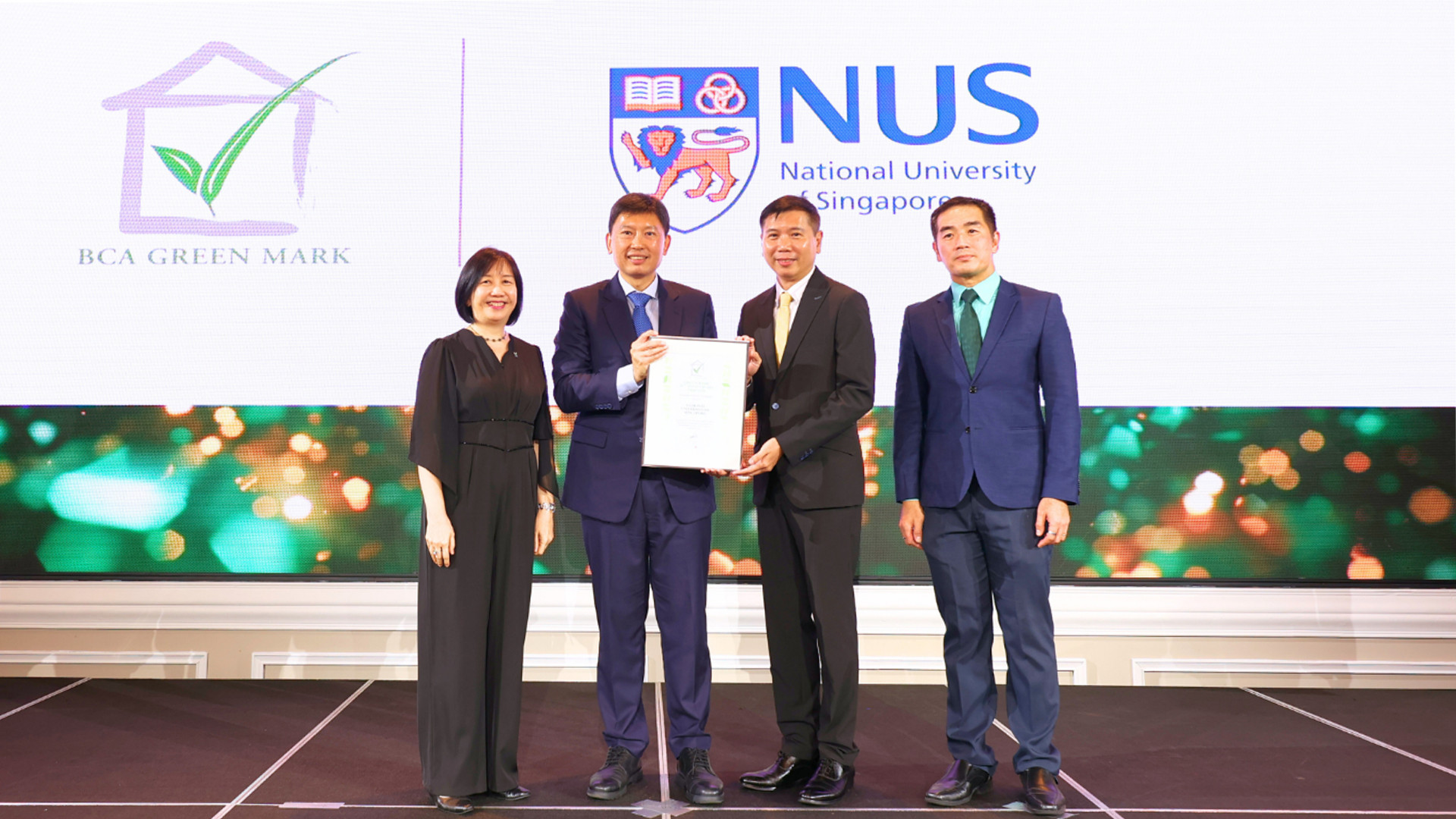 NUS Vice President (Campus Infrastructure) Mr Koh Yan Leng (second from right) received the BCA Green Mark Commemorative Certificate, on behalf of the University, from Minister for National Development Mr Chee Hong Tat (second from left). Photo credits: Singapore Green Building Council
Demonstrating its strong commitment to decarbonising the built environment through a portfolio of 64 Green Mark-certified buildings, NUS was awarded the Green Mark Commemorative Certificate at the Singapore Green Building Council Gala Dinner on 11 July 2025 for its continued support and contributions to Singapore’s green building journey. The event was held in celebration of the 20th anniversary of the Building and Construction Authority (BCA) Green Mark Certification Scheme.
Leading the way in high-performance green buildings
As of July 2025, six buildings in NUS have achieved the highest energy performance ratings under the Green Mark 2021 In-Operation scheme - Platinum Super Low Energy (SLE), Zero Energy (ZE), and Positive Energy (PE):
In 2021, NUS bagged the top BCA award for green buildings – the Green Mark Platinum Champion Award – for achieving 50 Green Mark Gold and above certifications for developments across its campuses.
One example is Ventus at NUS’ Kent Ridge Campus, where the Office of University Campus Infrastructure (UCI) is located. Through green building design and collaboration with building users to implement energy-saving measures, the Energy Use Intensity (EUI), which measures the total energy consumption of a building relative to its gross floor area, for Ventus was 49 kWh/m2 in FY2024, which is significantly lower than the average EUI for offices at 219 kWh/m2.
Beyond achieving high energy performance for the University’s new and existing buildings, green buildings also offer health and well-being benefits to building occupants. Comprehensive research by BCA and NUS in 2017 revealed that occupants experienced significantly better indoor environmental conditions than those in non-certified buildings, with measurable improvements in temperature control, humidity levels, air quality, and overall occupant satisfaction.
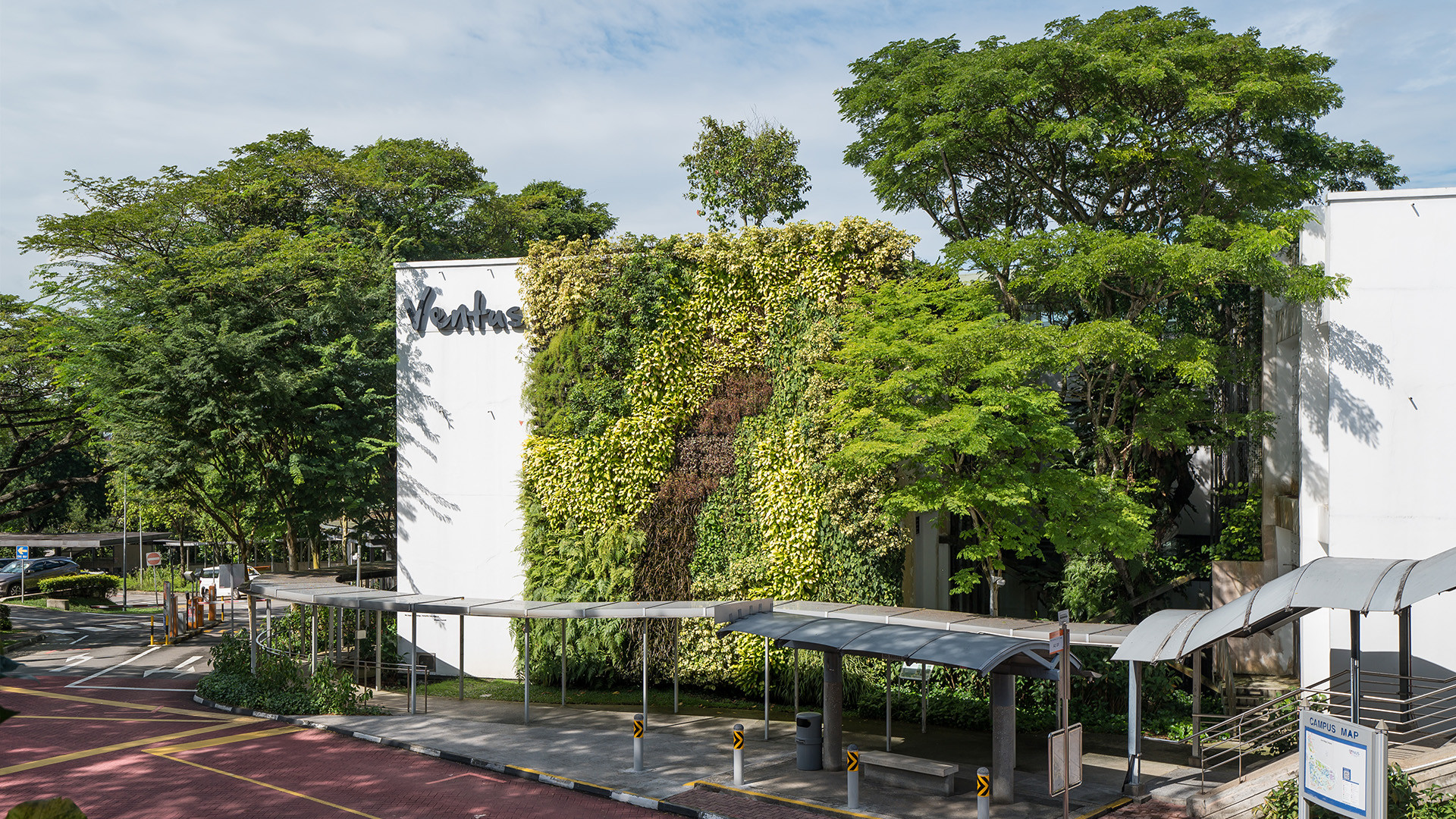 Ventus at Kent Ridge Campus consumed 260 MWh (EUI: 49 kWh/m2) of energy in FY2024 through green building design and collaboration with building users to implement energy-saving measures.
Translating innovation into practice
Beyond certification, NUS has played a pivotal role in pushing for an alternative cooling approach to reduce energy consumption while maintaining thermal comfort. Under Singapore’s new proposed Built Environment Decarbonisation Technology Roadmap, Associate Professor Adrian Chong from the Department of the Built Environment at the College of Design and Engineering, together with the UCI sustainability team, contributed to the development of a new technical standard known as TR 141:2025 for hybrid cooling systems, which aims to accelerate the deployment of hybrid cooling systems across building typologies. Their inputs were informed by the design and operational experience gained from implementing hybrid cooling technology in Net Zero Energy buildings at NUS. The new technical standard addresses the current gap in international standards and provides guidelines suited to our tropical climate.
Under the Campus Sustainability Roadmap 2030 Framework, the University aims to reduce Scope 1 and Scope 2 emissions by 30 per cent and reduce EUI by 20 per cent from the FY2019 baseline. By setting ambitious energy efficiency targets for its new and existing buildings, NUS aims to use the campus as a living lab where students can engage with real-world case studies for experiential learning and researchers can test-bed and develop innovations to improve building performance.
Supporting Singapore’s green building journey and Net Zero vision
NUS is committed to reducing both operational and embodied carbon across its building portfolio, in alignment with the national green building agenda and broader climate goals. As part of its strategy to address Scope 3 emissions, NUS has commissioned a study on sustainable construction, specifically on low embodied carbon materials, and is currently exploring the procurement of such materials for future NUS developments.
Vice President (Campus Infrastructure) Mr Koh Yan Leng said, “Greening the university’s buildings, such as by providing ample greenery, natural daylight, and more natural ventilation, has created a conducive environment for learning and working. Our commitment to bold energy targets helps shape the behaviours of future leaders and enables our community to engage with sustainable practices every day.”
By NUS University Campus Infrastructure
News from: https://news.nus.edu.sg/nus-recognised-for-green-building-excellence/