
search

 2025-10-11
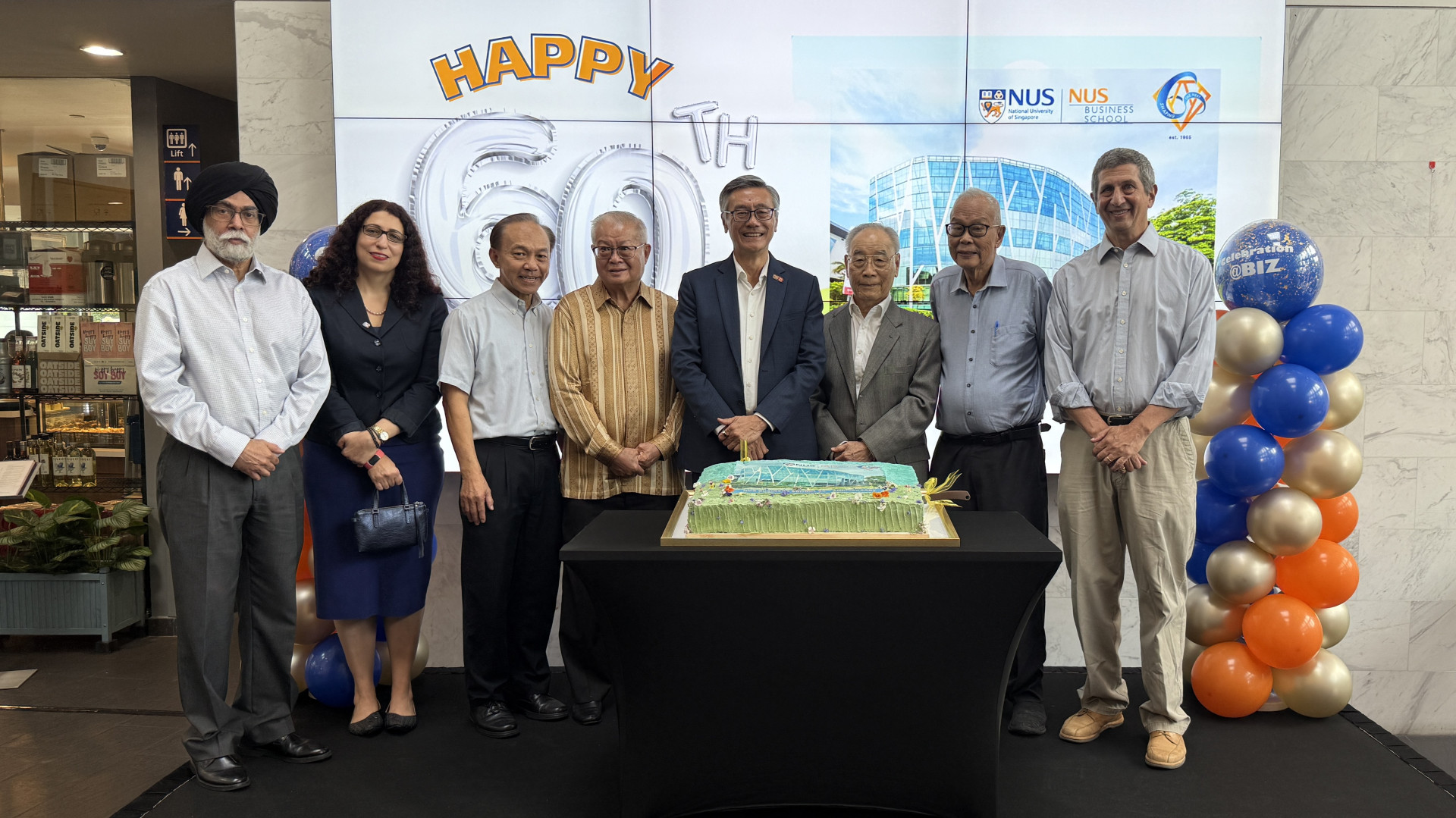 The 60th anniversary event was an opportunity for students, staff and past and present leaders of the NUS Business School to unite in celebrating the school’s diamond jubilee. (From left) Former Dean Professor Kulwant Singh; Associate Professor Jumana Zahalka, Deputy Dean; former Deans Professor Hum Sin Hoon and Professor Wee Chow Hou; NUS President Professor Tan Eng Chye; NUS Business School co-founder Mr Tan Yam Pin; former Dean Professor Lee Soo Ann; and Distinguished Professor Andrew Rose, Dean of NUS Business School.
Today, the Business School boasts more than 6,000 students across the undergraduate and postgraduate levels and an alumni network of more than 50,000. It is the top business school in Asia and ranks among the top ten globally.
NUS President Tan Eng Chye, NUS Business School co-founder Mr Tan Yam Pin, former deans Emeritus Professor Lee Soo Ann, Professor Wee Chow Hou, Professor Hum Sin Hoon and Professor Kulwant Singh, and Deputy Dean Associate Professor Jumana Zahalka joined Distinguished Professor Andrew Rose, Dean of the Business School, for a cake-cutting ceremony to open the event.
In his opening remarks, Prof Rose thanked the School’s founders and leaders for their contributions over the past six decades, as well as the faculty and staff whose education and research work form the core of the School’s reputation. “They are the reason why we’re attracting higher and higher quality students, and our reputation continues to grow,” he said.
The event included a fully subscribed masterclass on the future of sustainability in Asia, delivered by Professor Lawrence Loh, Director of the Centre for Governance and Sustainability, and an activity-packed carnival. Attendees enjoyed traditional snacks, arcade games, art booths and a dunk tank where their attempts to dunk Prof Rose and other faculty members raised money for a good cause.
 The carnival activities, which included a dunk tank, art booths and games, raised funds to support underprivileged students in the Business School.
Leading in Singapore and Asia
For former Business School leaders Mr Tan, Prof Lee and Prof Wee, the 60th anniversary milestone was an opportunity to reflect on the stark changes that have taken place since their time. The School’s enrolment growth is especially impressive for Mr Tan, who was there when the initial cohort of 21 was enrolled. In comparison, the undergraduate intake in recent years has been around 4,000 students per year.
Mr Tan reflected: “In 1963, when we first conceived the concept of starting a department of business administration, it seemed like a baby step forward to me. Now looking back, it was actually a giant leap, like (Neil) Armstrong said.”
Back then, business subjects like accountancy were considered more suitable for polytechnic diplomas, rather than degrees, Prof Lee recalled. However, things changed when Singapore gained independence in 1965 and needed to train its own finance professionals.
Prof Lee said, “The teaching of accounting and business administration became essential for businesses to survive, because the accountants had returned to England. By teaching accounting here, we upgraded the capabilities of Singapore and the economy.”
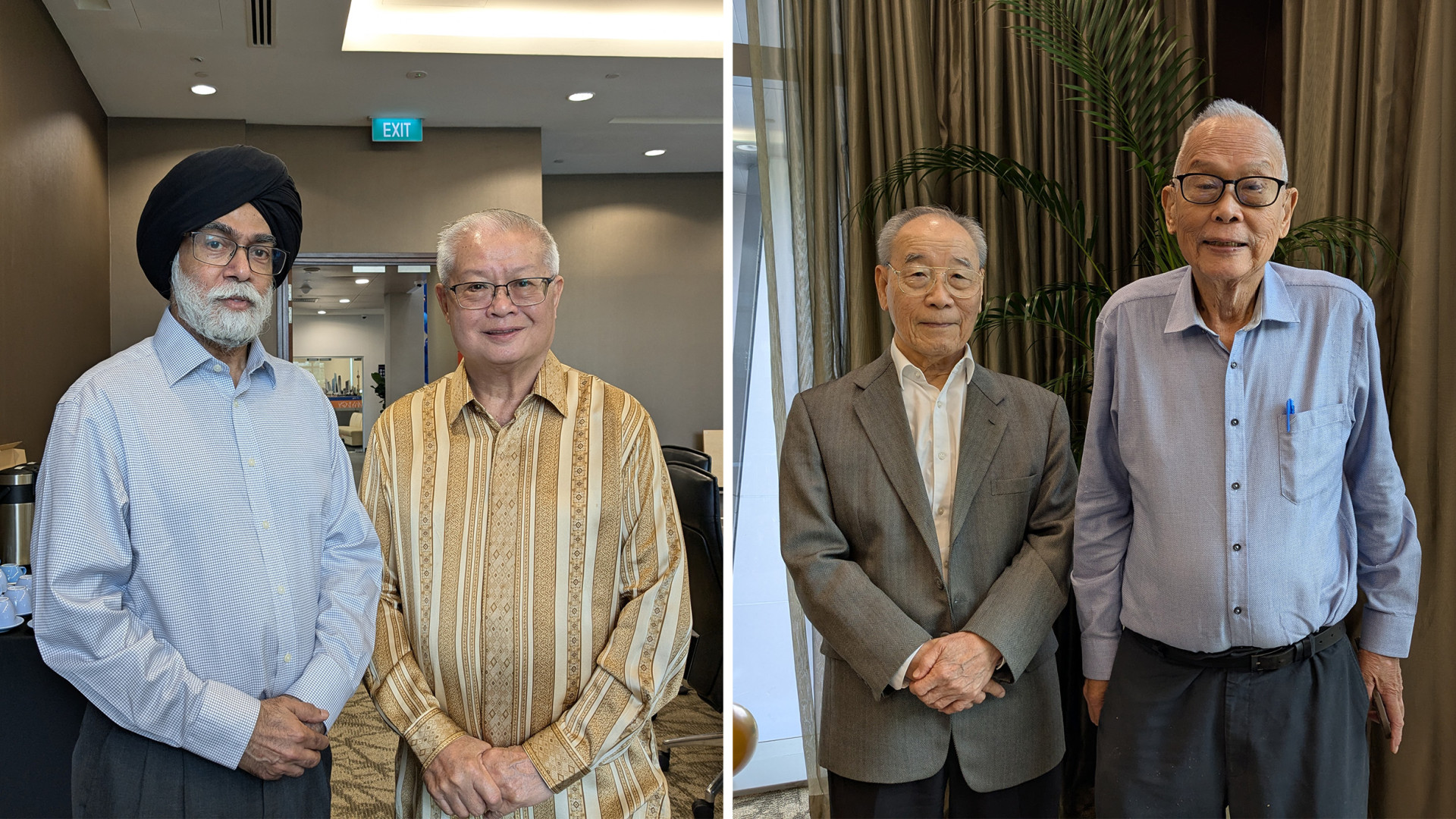 Former teachers and students reunited at the Business School’s 60th Birthday Bash. From left: Professor Kulwant Singh recalled studying under Professor Wee Chow Hou as an undergraduate in two different courses and serving as Sub-Dean and Vice Dean for Undergraduate (and later, Graduate) programmes during Prof Wee’s tenure as Dean; and NUS Business School co-founder Mr Tan Yam Pin reminisced about studying economics in the 1960s under Emeritus Professor Lee Soo Ann.
He looks forward to continued innovations in how the School prepares students for the changing business environment, such as by offering more double degree programmes and leveraging new technologies like Generative AI to help students learn faster and more broadly.
Prof Wee was pleased to see that several initiatives he introduced during his tenure from 1990–1999 have become an integral part of the School’s offerings and shaped its global focus.
For instance, he was an early advocate of the modular system over the traditional year-long curriculum, as it would allow students to retake individual modules as needed and embark on exchange programmes more flexibly. The same system has now been implemented across the entire University.
To strengthen the School’s influence as an authority on Asian business, he encouraged faculty members to initiate collaborations with authors of well-known business textbooks to develop new editions with Asian case studies and contexts. In addition, Chinese MBA and EMBA programmes were launched under his leadership, offering the first such programmes outside mainland China.
A project that he would have liked to execute before he stepped down was the creation of a bilingual master’s programme, which he believes would be critical to the Business School’s mission of providing business education with an Asian lens. He still hopes that this vision will eventually come to fruition in the School’s next chapter.
“Singapore as a nation has survived because the West wants to listen to our views about China, and the Chinese come to us to know about the West,” Prof Wee said. “As a society, our strength lies in playing that bridging role. It’s important that the government is trying to cultivate bilingualism, and our universities should complement this.”
News from: https://news.nus.edu.sg/nus-business-school-celebrates-60-years-of-shaping-tomorrows-leaders/