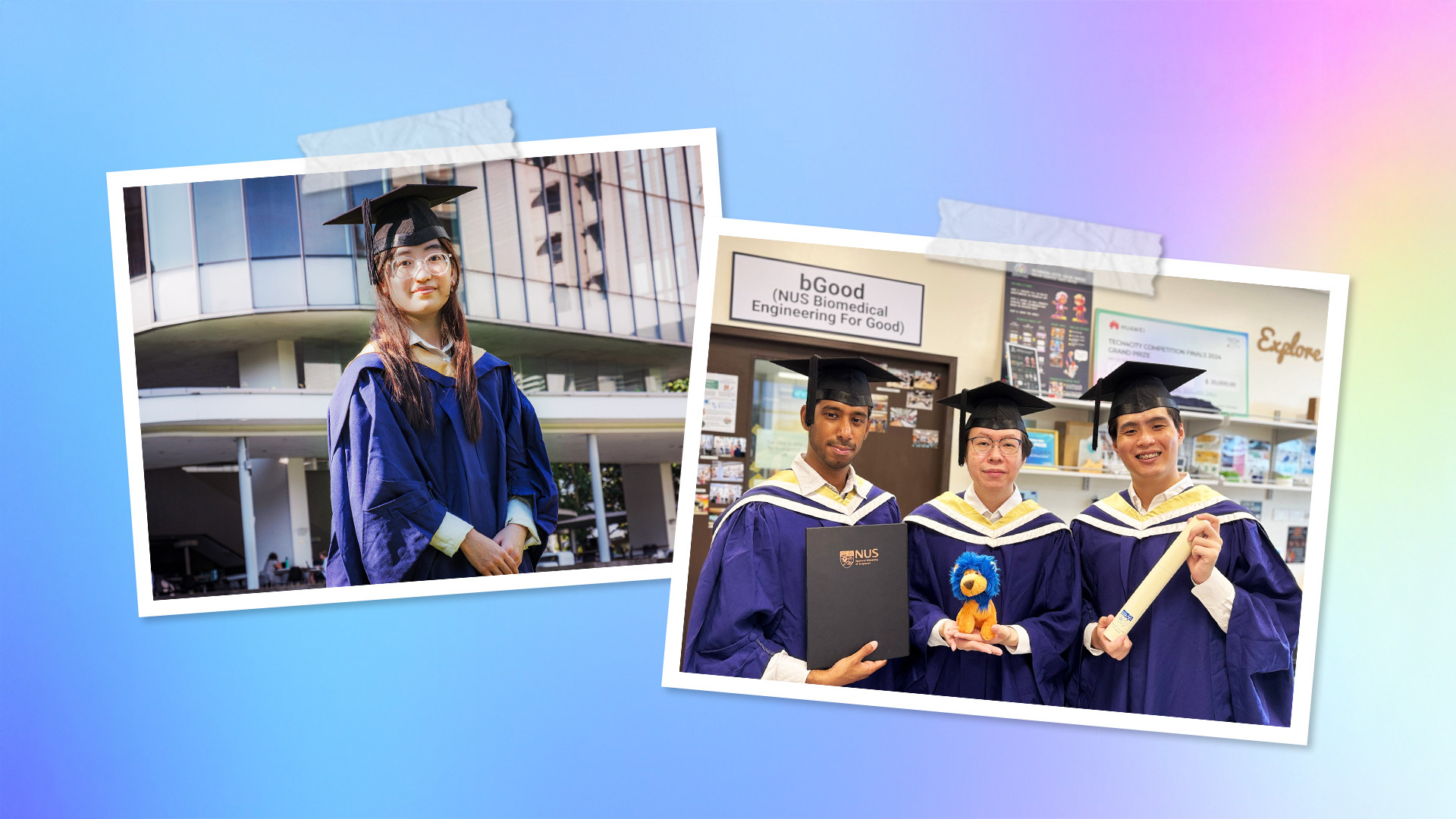
 (From left) NUS Class of 2025 students Clarissa Ong (Faculty of Science), Roshen Sidhu, Dylan Ee and Edwin Chuah (College of Design and Engineering) are putting their NUS skills to work for the causes they care about.
More than just a place to earn a degree, NUS is also where students learn about real-world challenges, such as those faced by underserved communities.
We speak to four graduates who are using the skills they learnt at NUS to contribute to causes they care about.
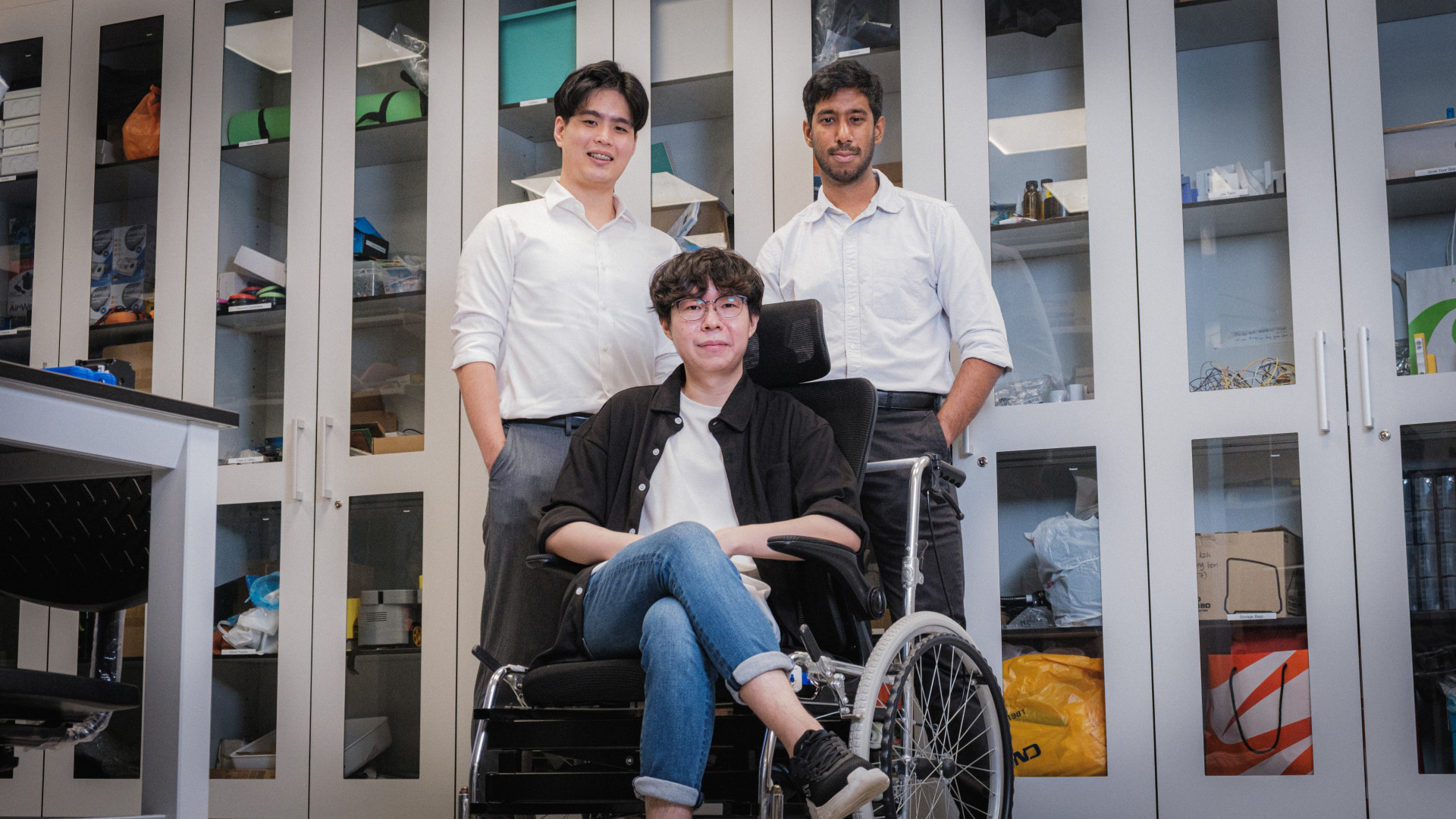 (Standing from left) Edwin Chuah, Roshen Sidhu and (seated) Dylan Ee sparked by their involvement in NUS CDE’s Biomedical Engineering for Good initiative, will be setting up a social enterprise to improve the lives of people with disabilities and their caregivers.Dylan Ee, Edwin Chuah, Roshen Sidhu: Designing solutions for persons with disabilities
Tapping their EZ-Link cards at the MRT fare gate is a routine few commuters here give much thought to. But for individuals with muscle-related disorders, which affect basic movements like walking and standing, the simple action can be a challenging task.
Due to muscle weakness, even raising their arms to tap their EZ-link card or asking for assistance at the gantry can be a strenuous task, said Edwin Chuah.
This was a task for the final year biomedical engineering major to solve as part of his coursework in the course
Assistive Technology for Persons with Disability offered under the
College of Design and Engineering (CDE) at NUS.
The course is also part of the Biomedical Engineering for Good (bGood) initiative under the
Department of Biomedical Engineering at NUS CDE, which lets students tap their biomedical engineering skills to develop solutions for real-world problems through technical electives.
With the guidance of his professors, Edwin designed a prototype called ARMovin. The robotic exoskeleton is attached to the user’s wheelchair and aids with physical movement such as raising their arm.
ARMovin has since been tested successfully by Edwin’s client who has Duchenne muscular dystrophy. “With ARMovin, I hope that (individuals with disabilities) will be able to use public transport to get around independently,” said Edwin.
His classmate, Dylan Ee, also took part in bGood with the aim of helping others. Together with his coursemate Roshen Sidhu, they developed WheeLift — a height-adjustable wheelchair that improves accessibility for users.
To their delight, the prototype, which took more than a year to develop, drew positive feedback from testers during a trial. “It wasn’t just a classroom project, it had a real purpose. Seeing our creation make a difference was quite rewarding,” said Dylan.
The trio — who are friends from their polytechnic days and are all 26 years old — plan to launch a social enterprise to take their solutions to market in the future.
Explaining the decision, Roshen said, “One of the main challenges is that even with a promising prototype, it can be difficult to find someone to carry the work forward after the semester ends — whether to further develop it or to bring it to market or the intended users.”
Thus, they were inspired to set up the social enterprise, which they have yet to name. “(It) aims to improve the quality of life for people with disabilities as well as their caregivers by providing affordable and customisable (assistive) devices. We hope to address these unmet needs,” said Edwin.
Dylan credits the bGood programme for the fruitful journey. “The programme allowed me to see problems through the eyes of the user,” he said. More crucially, it taught him to use his engineering skills to improve the lives of others.
“The shift from building for functionality to building for meaningful impact has shaped how we approach this social enterprise,” he added.
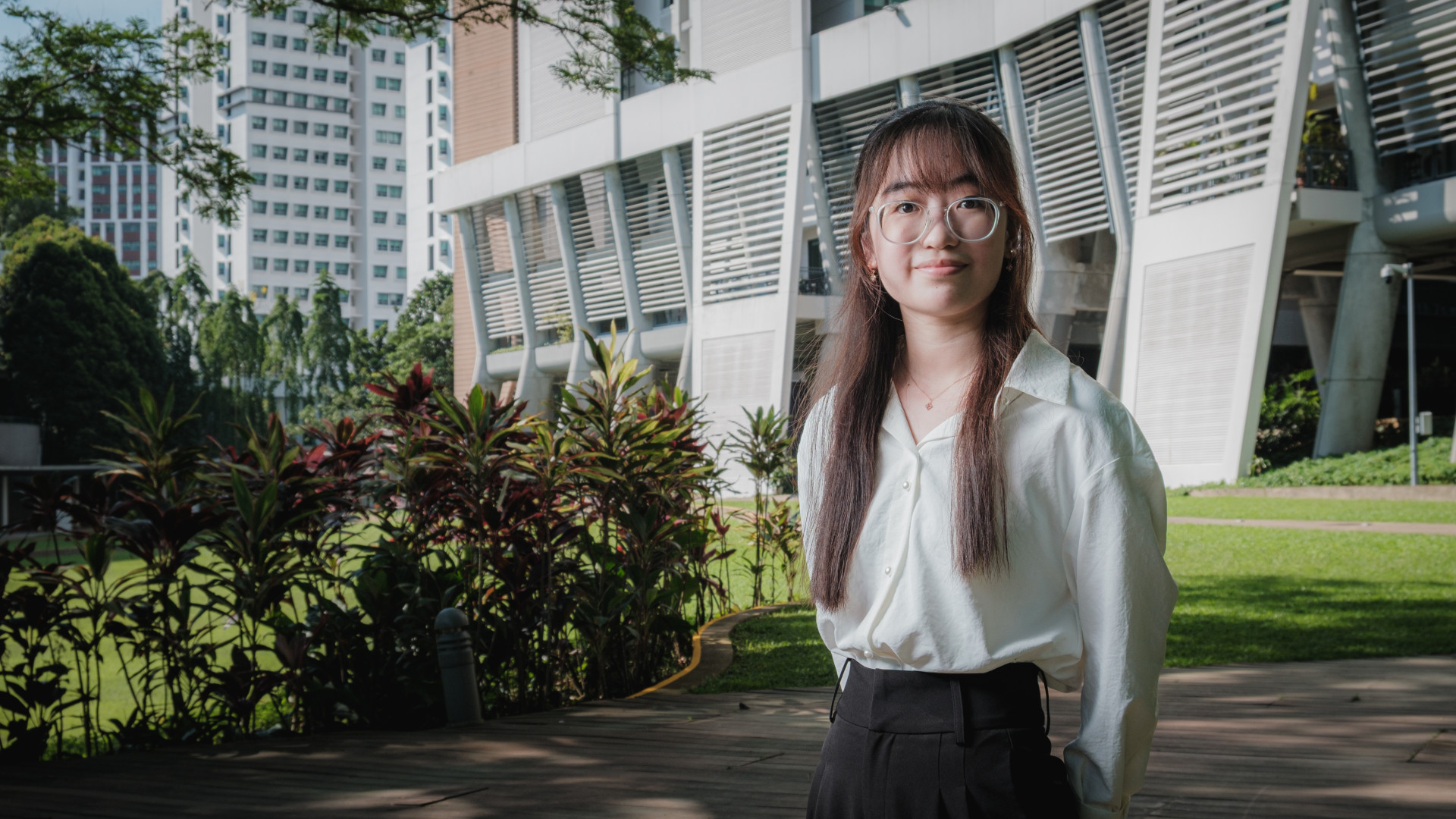 Life Sciences major Clarissa Ong leveraged NUS College of Humanities and Sciences’ interdisciplinary learning to not only master marketing and design for her polymer clay shop but also turn her passion into a fundraising platform for animal shelters.Clarissa Ong: Using her small business to fundraise for animals
 While some people picked up new hobbies during the COVID-19 pandemic,
NUS Life Sciences major Clarissa Ong turned hers into a business. In 2021, she set up an online shop called theclaywagon, which sells polymer clay handicrafts such as earrings and keychains.
The custom-made accessories were well-received — and she even managed to use her platform to raise funds for an animal shelter at risk of closing down.
“Although I was unsure how successful the fundraiser would be, I decided that there was no harm in giving it a shot,” said Clarissa, 23. “Through the efforts of myself and other generous donors, the shelter managed to avoid closure.”
Despite the promising start, building a business from scratch was not easy. As sales picked up, she had to juggle schoolwork with the time-consuming task of designing and handcrafting her wares.
She also had to navigate the unfamiliar world of business marketing. That prompted her to take up a communications course at the
NUS College of Humanities and Sciences (CHS).
“I learnt how to market my brand more effectively and design better collateral, such as posters, name cards, and information sheets,” Clarissa said.
What started as curiosity quickly turned into deep interest. She eventually completed a minor in Communications and New Media, and picked up coding in R and intermediate Korean through CHS courses.
In 2024, she further honed her retail skills by displaying her clay crafts at the Student Entrepreneur’s Market — supported by the university store NUS Co-op — where she modified her product packaging and display to cater to walk-in customers.
Her efforts to grow her business paid off. She went on to score a collaboration with food delivery company Deliveroo and sushi restaurant Maki-san, which commissioned her to produce keychains for a Chinese New Year 2025 campaign.
“I hope my creations will be able to bring joy to those who see them while also supporting meaningful causes,” said Clarissa, who is also an NUS Merit Scholarship and NUS Science – Dennis H. Murphy Merit Scholarship holder.
Besides fundraising for animals in need, she has volunteered with the Ministry of Social and Family Development as a befriender under ComLink — a government initiative that aims to uplift lower-income families for greater social mobility.
Clarissa notes that volunteering has opened her eyes to real-world problems outside of campus. “I often found myself learning valuable lessons from the families I met and being inspired by their resilience, strength, and generosity even in the face of uncertainty.”
After graduation, she hopes to pursue a career in science communication, which will marry her twin interests in life sciences and communications.
“NUS’ interdisciplinary approach has helped me develop key qualities like resilience and adaptability while equipping me with the skills to effectively communicate complex scientific concepts to a broader audience,” she added.
Her work on theclaywagon shows no signs of stopping either, and she has since expanded its offerings to include handmade ceramic products. Spurred by her earlier fundraising success, she continues to donate some of her profits to animal shelters.
“I used to believe that only big actions could truly make a difference,” she added. “However, throughout my academic journey, I received a lot of help from those around me, which allowed me to understand that even small gestures could make a big impact.”
News from:
https://news.nus.edu.sg/from-campus-to-community-nus-graduates-creating-real-world-impact/#:~:text=More%20than%20just%20a%20place%20to%20earn%20a,NUS%20to%20contribute%20to%20causes%20they%20care%20about.


 2025-08-07